
Find Ithaca Residents Through Records
No single record lists every Ithaca household. The Tompkins County assessment roll names a property owner and carries parcel details. The County Clerk index names parties to deeds, mortgages, judgments, and liens. A historical city directory can place a householder at an address in a given year. Each source answers one question. An owner entry never proves who occupies a home today.
Match the record to the question. A present address usually points to the assessment and GIS route. A known surname plus an old address fits a deed or printed street directory better. For one person, a court or estate index can confirm a distinct identity. Check the address trail first. Rotating among records is how resident lookup work stays honest.
- Search the address in the County assessment and Mapping Tompkins tools to identify the parcel, situs address, and municipality.
- Use the owner name or deed reference in the County Clerk’s PublicSearch index, then record the document date and parties.
- Check a second source that fits the period, such as an Ithaca directory, HistoryForge, or an official court index.
- Use the custodian’s counter, telephone, email, or written-request channel when a public interface does not expose the needed record.
- Keep the source date and jurisdiction with each result, because City of Ithaca, Town of Ithaca, and postal Ithaca are not the same boundary.
Ithaca Resident Records Offices
Most address and land records behind an Ithaca residents directory search live with Tompkins County. The City Clerk keeps City of Ithaca records. That office also handles city FOIL requests. The countywide Assessment Department values property for all 16 municipalities. County GIS maintains the address and parcel layers. Those layers separate city, town, and postal labels. Each office answers a narrower question than a broad name search.
For a full address-led sequence, use the Ithaca street directory. The offices above supply the current parcel and record index layer. They do not replace a careful check of record dates and municipal jurisdiction.
Note: A recorded document names its parties. It does not necessarily name every person who lived at the Ithaca address.
Ithaca Parcels Before People Names
The Assessment Department's Beacon landing page advertises property values and assessment details. It also covers ownership, sketches, and tax maps. Published final rolls show why it earns a first stop. Entries can include a tax-map parcel number, property location, class, owner, and owner mailing address. They may also list exemptions, assessed values, school district, account number, deed book and page, and map coordinates. That structure separates a property from the person tied to it.
- Parcel
- A numbered unit used in the tax map and assessment roll.
- Situs address
- The physical property location, which may differ from the owner’s mailing address.
- Index
- A searchable finding aid to records, not necessarily the complete record image.
- Criss-cross directory
- A historical directory arranged by address rather than surname.
County GIS serves as the spatial cross-check. Its public tools include parcel viewers, address or Printkey searching, and an elections address lookup. School maps and other layers are offered too. County map notices say the products compile deeds, surveys, base maps, and older materials. The legal description still belongs in the deed or survey.
Ithaca Deed Index Search Paths
The County Clerk's January 2026 PublicSearch modernization changed the official land-record index. It now forms a strong name-and-address trail. Quick Search and Advanced Search are both available. The search term supports a grantor or grantee, subdivision, document type, or document number. A recorded-date range can be added. A partial name needs an asterisk. Index-only searches treat multiple words individually. The OCR option treats them as a phrase.
| PublicSearch control | Ithaca records use | Format note |
|---|---|---|
| Search Term | Party, subdivision, document type, or number | Add * to a partial name |
| Start and End date | Narrow by recorded date | Use both ends of the range |
| Search scope | Choose index or document text | OCR treats multiword terms as a phrase |
| Quick date range | Recent document checks | From 24 hours through one year |
Finding deeds in Ithaca starts with the county's own portal. The Tompkins County PublicSearch screen lays out the fields and search scopes a visitor can use for this Ithaca residents directory route.
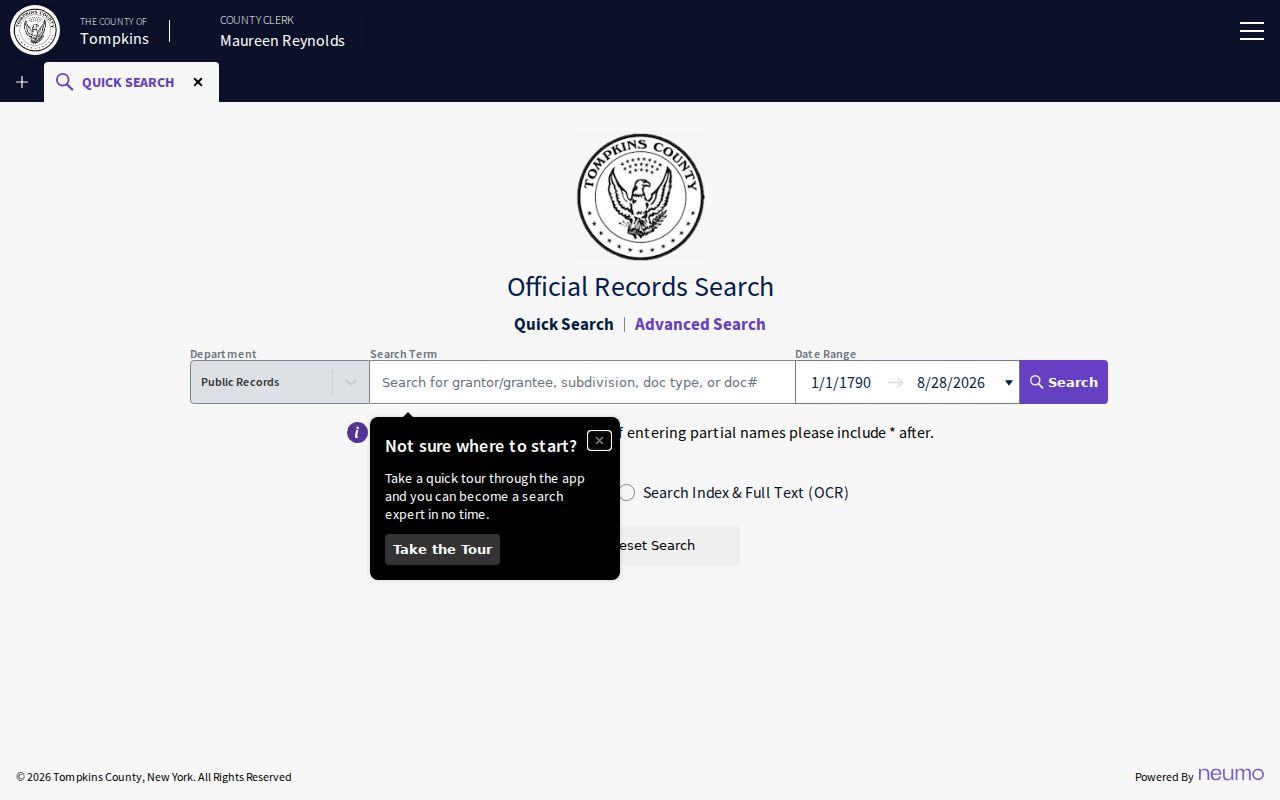
Treat a returned party name as a lead. Inspect the date, document type, and recorded relationship before treating it as evidence about an Ithaca address. The Clerk also documents counter, telephone, email, and staff-search channels when the online index falls short. Those options reach records the index alone cannot settle.
Note: An owner mailing address may differ from the physical property address. Retain both fields in an Ithaca search log.
Current Ithaca Resident Directories
Current directory-like sources each serve a defined audience. Assessment data is an owner and parcel source. The state voter tool serves registered-voter and poll-site purposes, not a general name directory. The deed index records document parties. Court and vital offices each carry their own access rules. Matching source to purpose keeps a casual result from standing in for a whole household.
| Ithaca source | What it can establish | Custodian | Access route |
|---|---|---|---|
| Assessment roll | Parcel, owner, mailing address, assessment details | Tompkins Assessment | Beacon, rolls, office help |
| Official records index | Parties to land and recorded documents | County Clerk | PublicSearch, staff, counter |
| Voter registration tool | A voter’s own registration or polling information | NYS Board of Elections | Restricted lookup workflow |
| Estate index | Probate and will-search leads | Surrogate’s Court | WebSurrogate and courthouse |
A name spanning several sources needs its own verification trail. The Ithaca resident lookup route focuses on that one-person question. It does not turn owner and voter records into blanket residence claims.
Official and commercial results are not interchangeable. The useful question is simple. Does a result trace to the custodian and date that created it? A residents directory built on that test holds up far better.
| Official Ithaca record route | Commercial people-finder category |
|---|---|
| States the keeper, record type, date, access rule, and a route to an underlying record or office. | May combine old addresses or similarly named people without showing a custodian’s current record. |
| Can be checked with Assessment, the County Clerk, a court clerk, or a historical repository. | Can be an unverified lead, but should never replace the responsible record custodian. |
Ithaca Voter Lookup Boundaries
New York's voter lookup asks a registered voter for county, last name, first name, date of birth, ZIP code, and address information. It exists for registration and polling purposes. Individual voter rolls are not an unrestricted online list. Election Law §3-103(5) limits voter-information use to elections purposes. The Tompkins Board of Elections is the proper office for its documented request route.
The NYS voter lookup shows the combination of identity and address fields. It does not work as a surname-only directory.
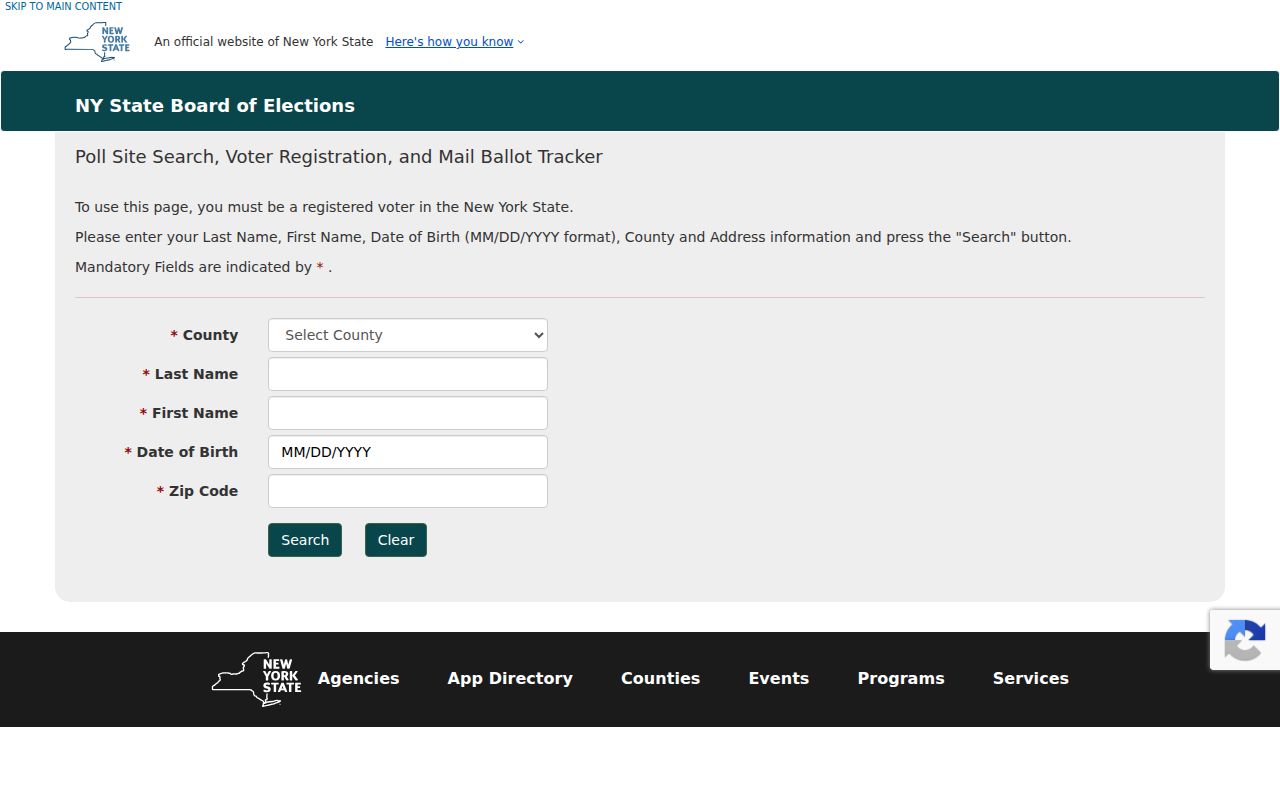
County notices say the Board of Elections moved to 214 W. State Street on August 24, 2026. Older forms may still list the former address. Check the current county contact before visiting a counter.
Ithaca Court and Estate Checks
Court files can untangle two Ithaca residents who share a name. But an empty search proves nothing. A missing case may be sealed, protected, or simply outside the tool's scope. NYS eCourts bundles WebCivil, WebCriminal, WebFamily, and NYSCEF Guest Search. Each covers the case types it supports. When the answer matters, the clerk holding the file remains the proper route. Use that route for a request or a certified disposition.
Estate work changes the toolkit. WebSurrogate searches by Party Name, File Number, Old Index, Index Book Pages, and Will Search modes. Its linked images stop at unrestricted filings from February 19, 2014 onward. Older unrestricted records may sit on courthouse public computers instead. The Tompkins County Courthouse sits at 320 N. Tioga Street.
Note: Ask the clerk whenever a court result, image, or certified copy matters. Any Ithaca estate question deserves that care.
Ithaca Vital Record Gateways
Vital records are not one tidy Ithaca residents directory. Tompkins County Whole Health holds birth and death records for events in the county. Marriage records stay with the city or town that issued the license. The state Department of Health keeps statewide records outside New York City, plus divorce certificates. Eligibility, identity proof, and record type all shape what a certified request needs.
Genealogy rules run on separate clocks. New York generally opens a birth copy after 75 years when the person is known deceased. A death copy opens after 50 years. A marriage opens after 50 years when both spouses are known deceased. Direct-line descendants can seek a waiver with proof. Those thresholds differ from certified-copy eligibility.
The Tompkins County Whole Health Vital Records page carries the local request path. It also posts current instructions.
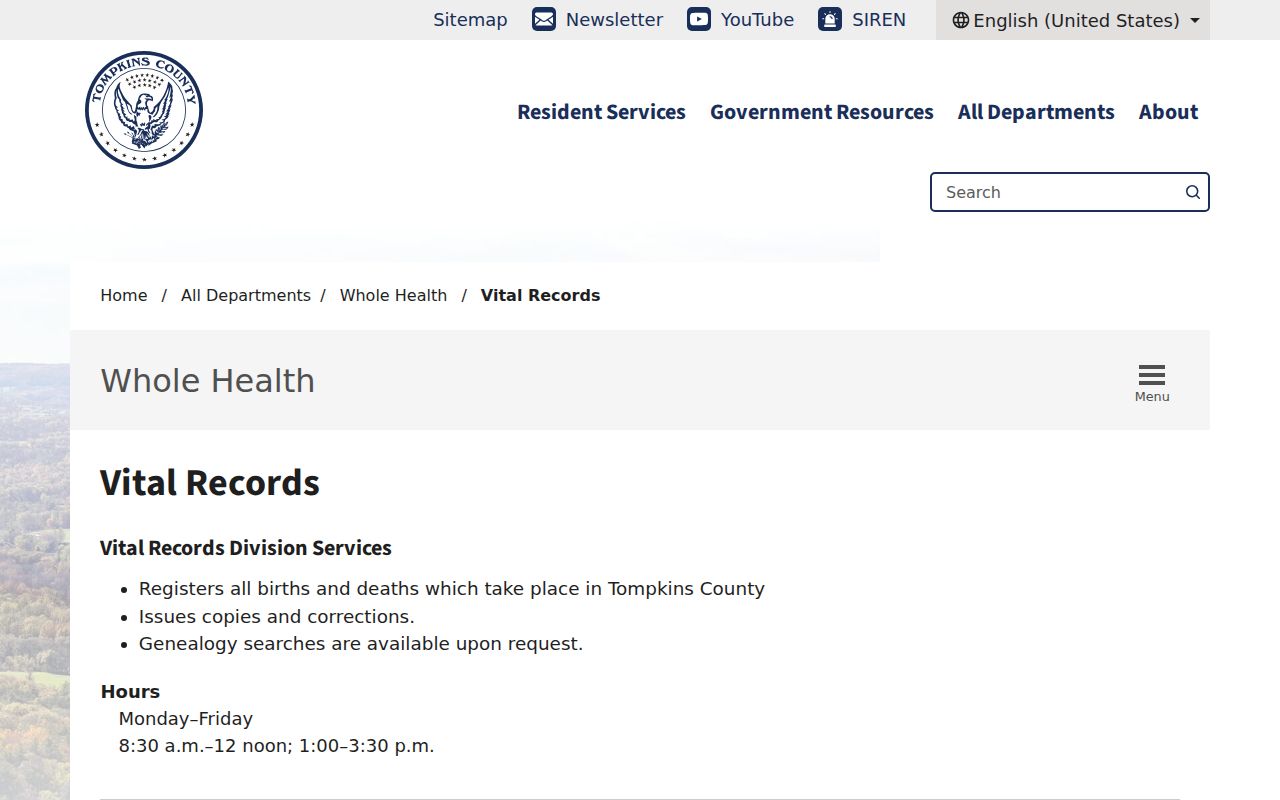
Whole Health posts birth and death copy procedures, local hours, identity requirements, and genealogy access on one page. Confirm the current fee and the jurisdiction-year coverage before mailing any request.
Historical Ithaca Resident Directories
Old directories are Ithaca's strongest resident trail. The city-directory run spans 1864 through 1989, and a digitized 1946 H. A. Manning volume sits at Tompkins County Public Library. One entry can tie a name, address, occupation, spouse convention, telephone, or institution to a single year. It is not a deed. It is not proof of who lives there now.
Three institutions cover different ground. The History Center holds directories, family files, obituaries, cemetery resources, newspapers, maps, and photographs. HistoryForge layers historic people onto buildings, maps, census material, tax photographs, and address searching. The full collection and the way to read an entry belong in the Ithaca city directories.
The 1946 Manning volume earns its own look. It covers citizens, a street and house directory, businesses, city, county, state, and federal offices, courts, societies, churches, a map, and armed-forces service listings. It can show that a person or organization appeared in that volume. From there, several record paths can confirm the connection. Record the page and directory year with every find.
Family files at the History Center offer a surname-first route when a civil record is closed or thin. That collection holds more than 2,000 family files, local newspapers reaching to 1819, maps, photographs, and obituary resources. TCPL runs a research service for anyone who cannot visit. These are access channels, not just background reading. Call ahead or search the catalog before a visit.
Ithaca Postal Names Need Checking
Postal Ithaca reaches past the City of Ithaca. The Town of Ithaca wraps around the city. Cornell's campus carries an Ithaca postal identity. Its records answer to a different municipal custodian. USPS sources list 14850, 14851, 14852, and 14853 in the Ithaca postal set. A ZIP name routes mail well. It proves nothing about who sits at an address.
Run the official USPS address lookup for the delivery ZIP first. Then bring in GIS and the assessment roll to pin down the parcel's municipality. Historic deeds and street directories may follow a postal convention with no ZIP at all.
Note: Keep postal ZIP, street address, and municipal jurisdiction as separate fields. Ithaca research notes work best that way.
Ithaca Public Role Verification
A public role calls for a different record than a street address. The New York State Education Department verification tools can return a professional's name, profession, license number, location, original license date, registration status, and discipline summaries reaching back to 1994. The Department of State licensee search filters by last and first name, license type, county, city, and ZIP. Each tool publishes only its own field set and status range.
Parcels owned by entities need the same care. The Department of State business database shows an entity's current name, organization date, jurisdiction, county, service-of-process address, registered agent, status, and for some corporations a CEO name and principal business location. A business result can explain an owner label in the assessment roll. It cannot establish a private resident at the property.
For a reconnection or estate question, the New York Comptroller unclaimed-funds search adds another official name-based tool. It requires a surname or business name, with optional first name, city, ZIP, and property ID fields. Treat a hit as a lead. Any claim still moves through the Comptroller's stated process, not the resident lookup itself.
Ithaca City Records by Request
Not every Ithaca record sits in a county index or a library directory. For city-held files, the City Clerk is the office to know. It manages records, public information, and FOIL requests for the City of Ithaca. You can submit a written request in person, by mail, or by email. The rule to remember is simple. A request seeks a record that already exists. No office must build a new compilation for you.
New York's FOIL, found in Public Officers Law Article 6, sets the clock. Agencies generally have five business days to respond. They may grant, deny, acknowledge, or explain that a record cannot be located. An acknowledgment includes an approximate date when more time is required. The Ithaca City Clerk is the starting point. It handles city records and the current request process.
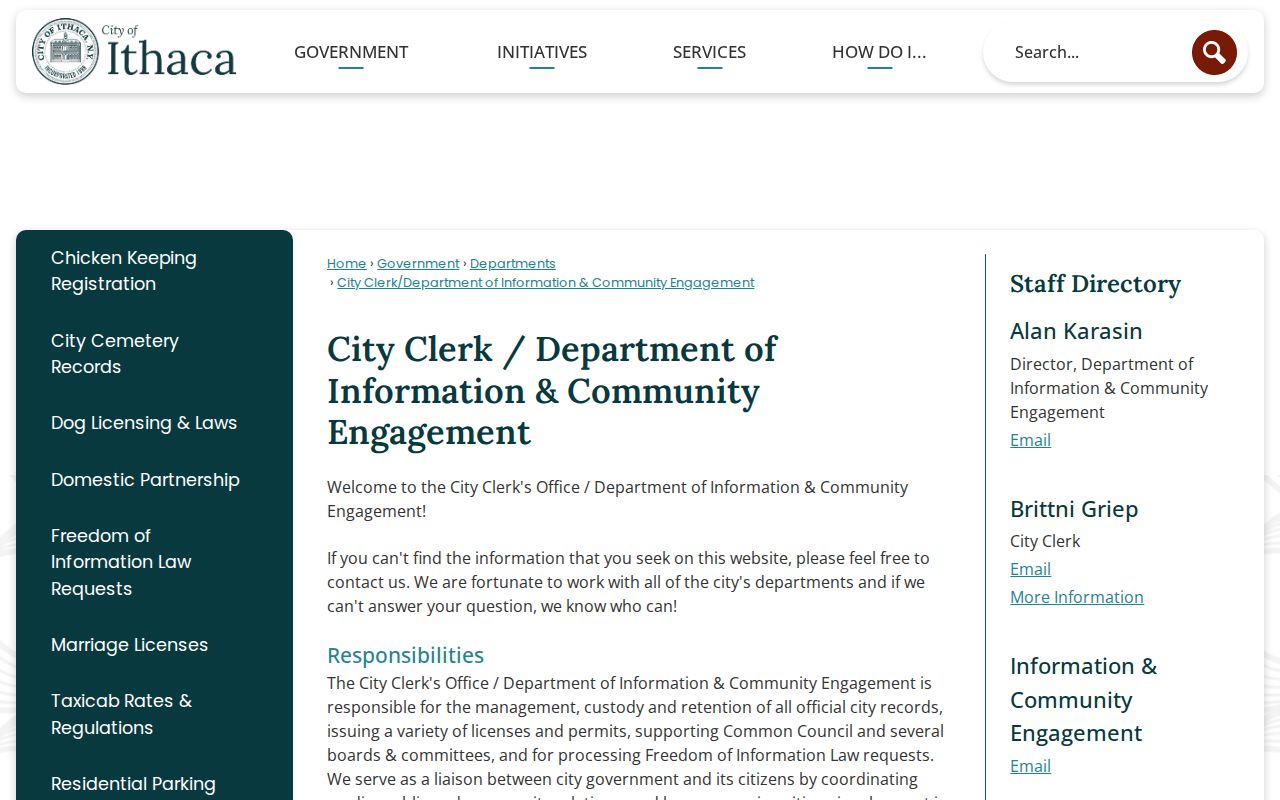
City materials describe the Clerk's public-records role too. Permits and older city files often are not posted online. Ask the custodian for the existing record. Use the current channel, whether paper or email.
Note: Request a defined existing city record and keep the response date. FOIL does not require a new report.
Ithaca Research Beyond Online Results
When an online search stalls, the next move depends on the record. The County Clerk takes specific staff-search requests in person, by phone, or by email. The courthouse clerk handles file access that eCourts does not deliver. Vital-record questions go to Whole Health or the issuing city or town clerk. Their stated rules apply. TCPL runs a local-history research service for people who cannot visit. The History Center books appointments for its research room.
Older names demand flexible searching. Historic directories lean on initials, spouse conventions, and occupations. PublicSearch needs an asterisk for a partial name. HistoryForge's address suggestion matters, since improvised formatting can miss a building entirely. Write down each spelling you tried. Note the source date, and note whether the result was an index, an image, or a certified copy. That small recordkeeping habit makes an Ithaca residents directory search far easier to verify later.
FOIL is a limited fallback, not a wand. It covers records that already exist. No agency must create a custom list or analysis on request. Identify the record and its likely custodian, then send the request. New York agencies generally respond within five business days. The response grants, denies, or acknowledges with an approximate date. It may also explain that a diligent search turned up nothing. Privacy exemptions, sealed files, and more specific laws can still control what you get.