
Ithaca City Directory Collections
The most complete documented collection is held by the History Center Research Library. Its Ithaca run spans 1864 through 1989, with several early volumes also reaching other Tompkins County towns. The collection brings together local publishers, while surviving modern volumes are especially associated with H.A. Manning. Some directory material can also be read through Tompkins County Public Library resources.
| Collection | Years | Where held | Access |
|---|---|---|---|
| Ithaca directories | 1864-1989 | History Center Research Library | Research-library visit, appointment strongly advised |
| Early multi-town volumes | 1868, 1872, 1892 | History Center collection | Includes other Tompkins County towns |
| H.A. Manning digitized volumes | 1923-1986 permission range | TCPL local-history digital archive | Selected volumes online |
| Ithaca Directory, Volume XLVI | 1946 | TCPL local-history archive | Digitized PDF |
Those dates describe what is documented, not an uninterrupted annual set. Confirm a needed year in the catalog before a visit. A missing result may reflect an unscanned item, a different volume, an initial rather than a full given name, or a household recorded at another address.
Note: Confirm the needed directory year in the catalog before planning an Ithaca research-room visit.
History Center Access for Ithaca Directories
The History Center is at 110 N. Tioga Street on the Ithaca Commons. Research-library visits are by appointment, and the archive contact listed by the Center is archives@thehistorycenter.net, 607-273-8284 ext. 2. The library is free for Tompkins County residents; a $10 research fee applies to non-county residents. Expanded archivist labor is charged hourly, with card-only payment handled through an email invoice.
Bring a plan for the surname, address, date range, and alternate spellings. A researcher card and sign-in record contact information and payment expectations. Reading-room practice matters too: belongings go in lockers, and bags, backpacks, notebooks, and pens stay off the table. Paper and pencils are supplied. Laptops and phones are permitted, non-flash photos are encouraged, and food or drink is not allowed.
The shelf is wider than the directory volumes. Its holdings include more than 2,000 family files, more than 200 oral histories, 250 bound ledgers, 440 scrapbooks, 1,200 maps, more than 3,500 local-history books, newspapers from 1819, and photographs from 1865 onward. The catalog supports name, subject, and place searches, but only part of the collection is online.
The History Center's archives and library page is the source for this research-library view.
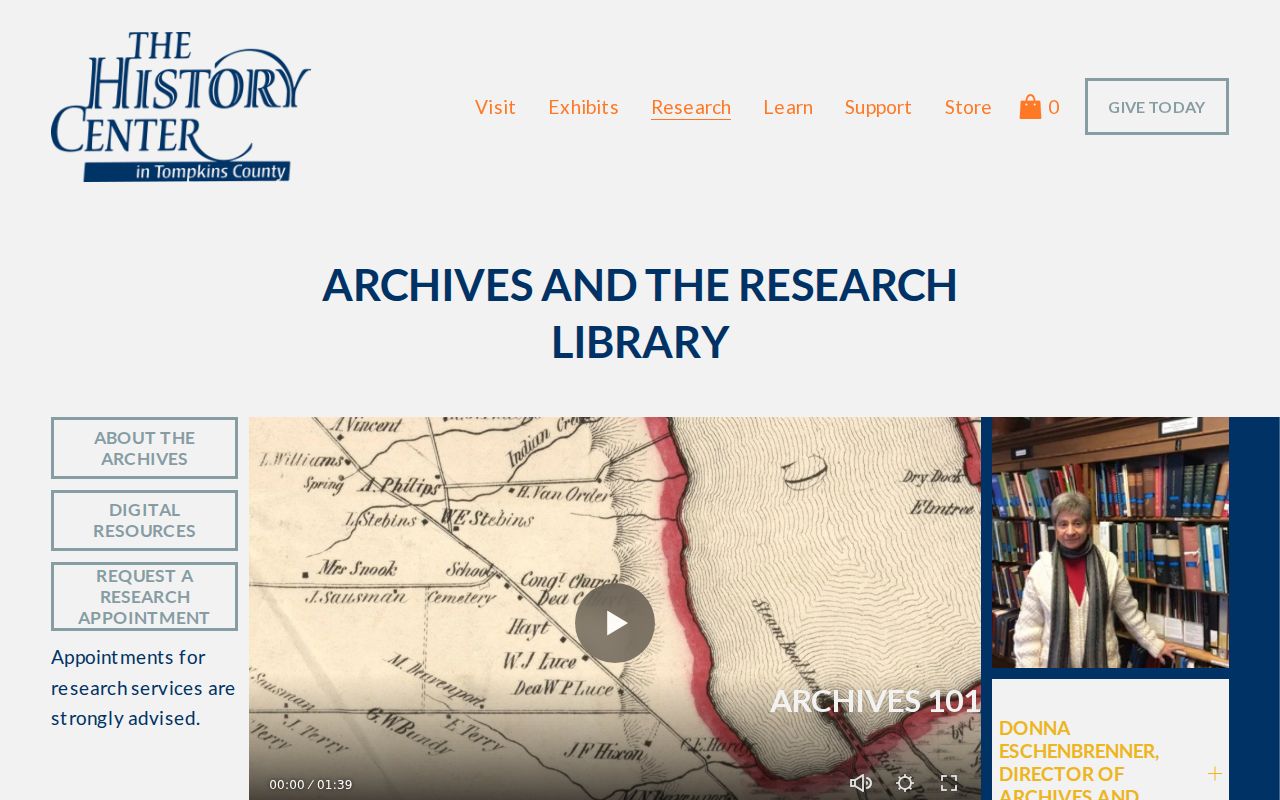
Use the image as a reminder to arrange access before relying on a catalog hit. A catalog record may lead to a finding aid, a physical volume, or a digitized item rather than a fully searchable directory page.
Ithaca's 1946 Directory
The digitized 1946 Ithaca Directory is a concrete place to learn the collection's layout. Its metadata identifies Bellows Falls, Vermont, as the H.A. Manning Company publisher, names Tompkins County Public Library as owner, assigns it to Local History, and lists 432 pages. The title page calls it an Ithaca directory for the year beginning February 1946.
That single volume is broader than an alphabetical name list. It contains general directories of citizens, a classified business directory, a street and house directory, a map, city government, societies, churches, county, state and United States government, courts, and citizens serving in the armed forces. The publisher's notice about a free directory library at the Ithaca Chamber of Commerce, 210 N. Aurora Street, describes a historical service location, not a current one.
New York Heritage's History Center collection page documents another route to selected local materials, including photographs, oral histories, maps, and transcriptions available through the historical institution.
New York Heritage's History Center listing provides the source for this selected-materials view.
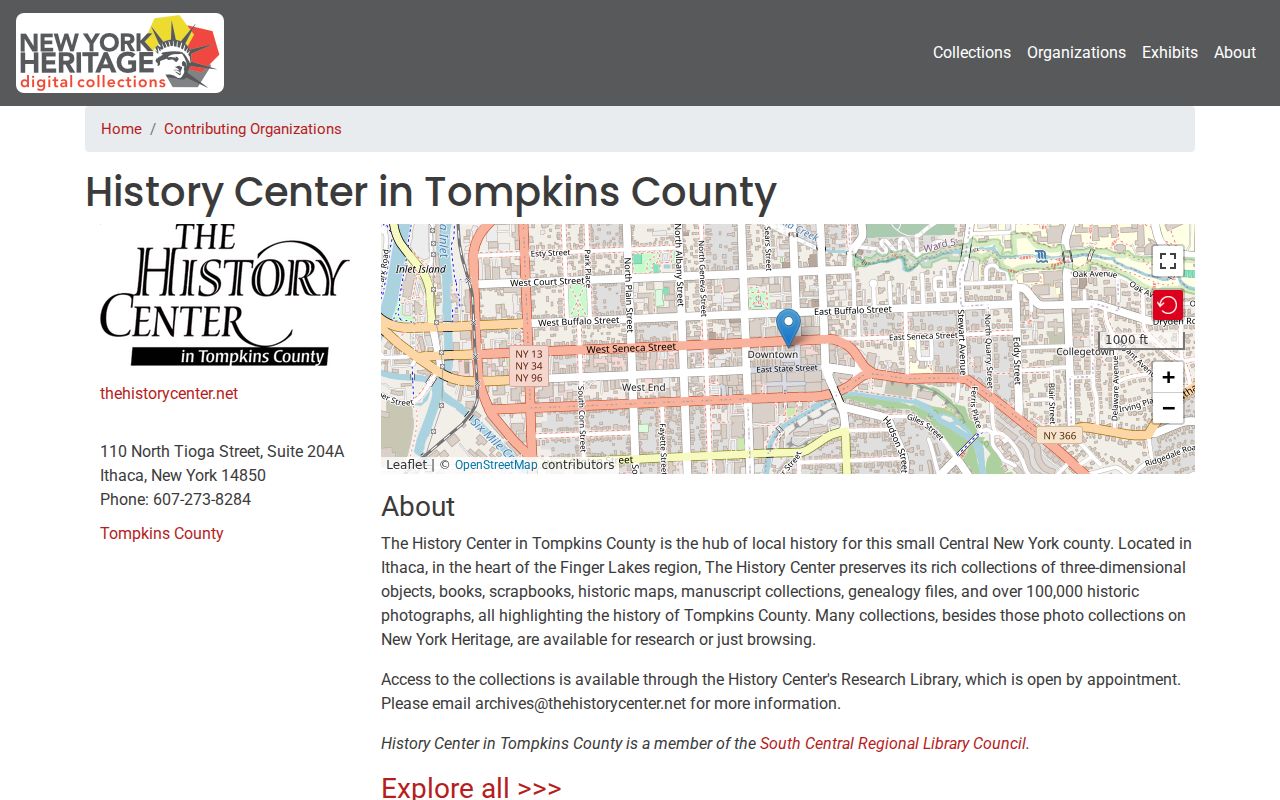
Selected online material complements, rather than replaces, the reading-room holdings. The History Center notes ongoing digitization, transcription, and data cleanup, so a useful directory lead may still require an appointment or a question to staff.
Note: The historical Chamber directory-library notice describes a past access point, not a current service location.
Reading Ithaca Directory Entries
Read the part of the volume that matches the question. In the 1946 PDF, the index gives entries such as “Adams Armand L 91” and “Adams Arthur G 91,” combining a surname, given-name initials, and a page pointer. A classified lawyer entry is headed “Name / Address / Tel.” and then places alphabetized names beside an address and telephone number. County-government pages pair office roles, names, and office context.
| Alphabetical index | Surname, given-name initials, and a page pointer in the inspected 1946 volume. |
|---|---|
| Classified listing | Category, name, address, and telephone under the printed “Name / Address / Tel.” heading. |
| Street and house section | A street-order route for locating people or institutions recorded at a number. |
| Government pages | Office role, person, and office context. |
| Printed marks | Transcribe only marks whose meaning is defined in that volume's own key. |
- Criss-cross directory
- A street-order listing used to work from an address toward a recorded person or household. No separate Ithaca criss-cross series was documented in the reviewed sources.
- Householder index
- A term for an index organized around a household name. Confirm the label and scope in the specific volume before treating a section as one.
- Abbreviation key
- The volume's own explanation of initials or symbols. Photograph or transcribe it first; the inspected capture did not establish a universal Ithaca key.
Do not infer a spouse notation, owner mark, renter mark, or residence meaning when the page key is unavailable. The street-and-house section is documented as part of the 1946 volume, but the research capture did not expose its entire layout cleanly.
Ithaca Directory Timeline
The surviving record has a useful sequence. Ithaca directories begin in the documented collection in 1864. Ithaca became a city in 1888, and the long directory run eventually continued to 1989. H.A. Manning digitization permission covers the 1923 through 1986 range, while the 1946 book is labeled Volume XLVI. These milestones help place a search without pretending every intervening year is equally available online.
- 1864: the History Center's documented Ithaca directory run begins.
- 1888: Ithaca becomes a city; older place and street names may need separate checking.
- 1923-1986: H.A. Manning directory digitization permission covers this range.
- 1946: the TCPL digitized H.A. Manning volume identifies itself as Volume XLVI.
- 1989: the documented History Center Ithaca run ends.
For older addresses, historical names can matter. Factory Street became Stewart Avenue when Ithaca became a city in 1888. South Hill sources also identify Creek Road as today's Giles Street and the Owego Turnpike as today's Hudson Street. Search both forms when the year crosses a change.
Note: A chronological gap or a new street name is a reason to test another source, not proof that a household vanished.
HistoryForge for Ithaca Addresses
HistoryForge, developed by the History Center beginning in 2016 with local-history enthusiasts, ties interactive maps, archival records, census data, buildings, and neighborhood information together. Its people search can filter by birthplace, occupation, industry, race, sex, and census-specific fields such as radio ownership in 1930. Those filters are useful for separating similar historical names after a dated volume has supplied a possible address.
Its Places search starts with an address. Enter the address and select the suggested format from the dropdown instead of inventing a format. Historic building records combine censuses, directories, maps, and other materials. That makes the tool a strong bridge between a historical Ithaca address and a named person, while the printed volume remains the better source for a year-specific entry.
HistoryForge is limited to its transcribed and digitized sources and focuses on selected late nineteenth- and early twentieth-century material. Pair it with the History Center, TCPL local history and genealogy resources, and the source volume. TCPL's research service handles remote questions, while its archive includes local-history books, maps, newspapers, church material, and genealogy resources. County health genealogy material also identifies Cornell University Library's Olin Library Department of Manuscripts and Archives as a local manuscript fallback. Its absence of a result does not settle a historical question.
Tracing Ithaca City Directories
Start by fixing the address and municipality. A postal Ithaca address can belong to the City of Ithaca, Town of Ithaca, or Cornell-area geography, so an assessment roll, GIS parcel map, or historical map may be needed before choosing a volume. Begin with the edition closest to the known event, then read both the alphabetical name section and the street-and-house section.
- Record each spelling, initials, address, telephone, and any notation that the volume itself defines.
- Check the adjacent year for a move, a change in household composition, a business or institution at the address, or a telephone change.
- Use the street-and-house section to record every entry at that number, including an institution or a second household.
- Pair the directory date with HistoryForge or census material, remembering that the County Clerk's 1825-1925 census set is incomplete.
- Use the History Center obituary listings and marriage or death notices to test a disappearance, remarriage, death, or move.
A directory occupant is not necessarily the title holder, and an assessment owner's mailing address is not necessarily the property location. If the question turns into a current address or parcel question, use the Ithaca by-street directory for the modern address record route. If a historical name needs present-day verification, use the Ithaca resident lookup tools rather than treating an old listing as current evidence.
Ithaca Directory Limits
A historical volume is a community snapshot compiled for its own time. A resident may have moved after compilation, a name may be misspelled, an address may be institutional, and an entry may use initials or a spouse convention. A disappearance can mean a move, a death, another spelling, an unlisted household, or a gap in the run. It does not identify a current resident by itself.
Keep the source date, volume, page, and municipality with every transcription. For a difficult search, ask the History Center whether telephone books, reverse directories, or unpublished address indexes supplement the printed street section. Its catalog is partial, and the county's historical census resources are incomplete. Those limits are useful clues about which record series to try next.